New: A new, unread, unused book in perfect condition with no missing or damaged pages. See the ... Read moreabout the conditionNew: A new, unread, unused book in perfect condition with no missing or damaged pages. See the seller's listing for full details. See all condition definitionsopens in a new window or tab
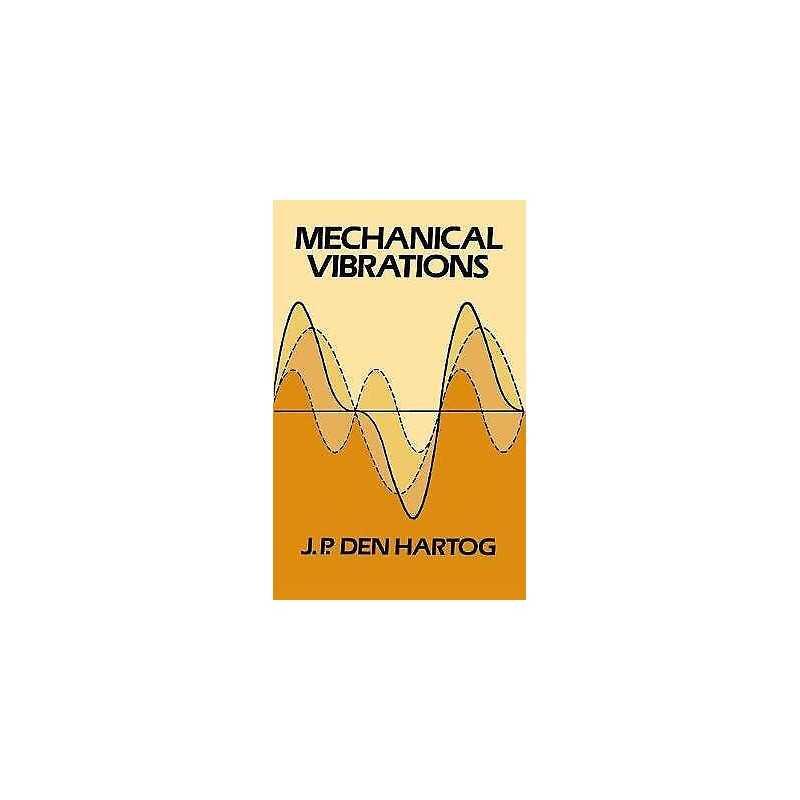
This classic text combines the scholarly insights of its distinguished author with the practical, problem-solving orientation of an experienced industrial engineer. Abundant examples and figures, plus 233 problems and answers. This classic textbook by J. P. Den Hartog, retired professor of mechanical engineering at MIT, reflects the author's unique ability to combine the scholarly insight of a distinguished scientist with the practical, problem-solving orientation of an experienced industrial engineer. Although mathematics plays a role in the subject, Den Hartog employs the simplest possible mathematical approaches. His lucid explanations of complex problems are presented in a direct style and supported by illustrative models. Numerous figures in the text enhance its value as a basic foundation in a field which Den Hartog calls a necessary tool for almost every mechanical engineer. The author examines such topics as the kinematics of vibration (including harmonic motions and non-harmonic periodic motions), degrees of freedom, gyroscopic effects, relaxation oscillations, Rayleigh's method, natural frequencies of torsional vibration, Karman vortices, and systems with variable elasticity. Drawing on his experience as an engineer in private industry and in the U.S. Navy's Bureau of Ships, Den Hartog applies theory to practice, discussing the effects of vibrations on turbines, electrical machines, helicopter rotors and airplane wings, diesel engines and electrical transmission lines. As a special aid to classroom work or self-study, this practical text includes an extensive selection of 233 problems and answers that test the student's mastery of every section of the book. In addition, a highly useful Appendix contains A Collection of Formulas for determining the load per inch deflection of linear springs, the load per radian rotation of rotational springs, the natural frequencies of simple systems, the longitudinal and torsional vibration of uniform beams, the transverse or bending vibrations of uniform beams, and the vibrations of rings, membranes, and plates. When Mechanical Vibrations was first published in 1934, it was a pioneering work in a field which had just been introduced in America's technical schools. In fact, the author wrote it to assist him in teaching the subject at Harvard. During the life of the book, he says, from 1934 on, the art and science of engineering has grown at an astonishing rate and the subject of vibration has expanded with it. Professor Den Hartog's constant revisions have kept his book at the forefront of this vital subject, as useful today as its earlier versions were to students of the past.
Good condition -A book that has been read, but is in good condition. Minimal damage to the book cover.The majority of pages are undamaged might be with some creasing or tearing, and pencil underlining of text. No writing in the margins, no missing pages.
Good condition -A book that has been read, but is in good condition. Minimal damage to the book cover.The majority of pages are undamaged might be with some creasing or tearing, and pencil underlining of text. No writing in the margins, no missing pages.
Good condition -A book that has been read, but is in good condition. Minimal damage to the book cover.The majority of pages are undamaged might be with some creasing or tearing, and pencil underlining of text. No writing in the margins, no missing pages.
Good condition -A book that has been read, but is in good condition. Minimal damage to the book cover.The majority of pages are undamaged might be with some creasing or tearing, and pencil underlining of text. No writing in the margins, no missing pages.
Very good condition -A book that has been read and does not look new, but is in excellent condition. Don't have obvious damage to the book cover. No missing or damaged pages, no creases or tears, no underlining or highlighting of text, and no writing in the margins.
Good condition -A book that has been read, but is in good condition. Minimal damage to the book cover.The majority of pages are undamaged might be with some creasing or tearing, and pencil underlining of text. No writing in the margins, no missing pages.
Good condition -A book that has been read, but is in good condition. Minimal damage to the book cover.The majority of pages are undamaged might be with some creasing or tearing, and pencil underlining of text. No writing in the margins, no missing pages.
Good condition -A book that has been read, but is in good condition. Minimal damage to the book cover.The majority of pages are undamaged might be with some creasing or tearing, and pencil underlining of text. No writing in the margins, no missing pages.
Good condition -A book that has been read, but is in good condition. Minimal damage to the book cover.The majority of pages are undamaged might be with some creasing or tearing, and pencil underlining of text. No writing in the margins, no missing pages.
Good condition -A book that has been read, but is in good condition. Minimal damage to the book cover.The majority of pages are undamaged might be with some creasing or tearing, and pencil underlining of text. No writing in the margins, no missing pages.
Good condition -A book that has been read, but is in good condition. Minimal damage to the book cover.The majority of pages are undamaged might be with some creasing or tearing, and pencil underlining of text. No writing in the margins, no missing pages.
Good condition -A book that has been read, but is in good condition. Minimal damage to the book cover.The majority of pages are undamaged might be with some creasing or tearing, and pencil underlining of text. No writing in the margins, no missing pages.
Good condition -A book that has been read, but is in good condition. Minimal damage to the book cover.The majority of pages are undamaged might be with some creasing or tearing, and pencil underlining of text. No writing in the margins, no missing pages.
Very good condition -A book that has been read and does not look new, but is in excellent condition. Don't have obvious damage to the book cover. No missing or damaged pages, no creases or tears, no underlining or highlighting of text, and no writing in the margins.
Good condition -A book that has been read, but is in good condition. Minimal damage to the book cover.The majority of pages are undamaged might be with some creasing or tearing, and pencil underlining of text. No writing in the margins, no missing pages.
Good condition -A book that has been read, but is in good condition. Minimal damage to the book cover.The majority of pages are undamaged might be with some creasing or tearing, and pencil underlining of text. No writing in the margins, no missing pages.
€17.97
New: A new, unread, unused book in perfect condition with no missing or damaged pages. See the ... Read moreabout the conditionNew: A new, unread, unused book in perfect condition with no missing or damaged pages. See the seller's listing for full details. See all condition definitionsopens in a new window or tab