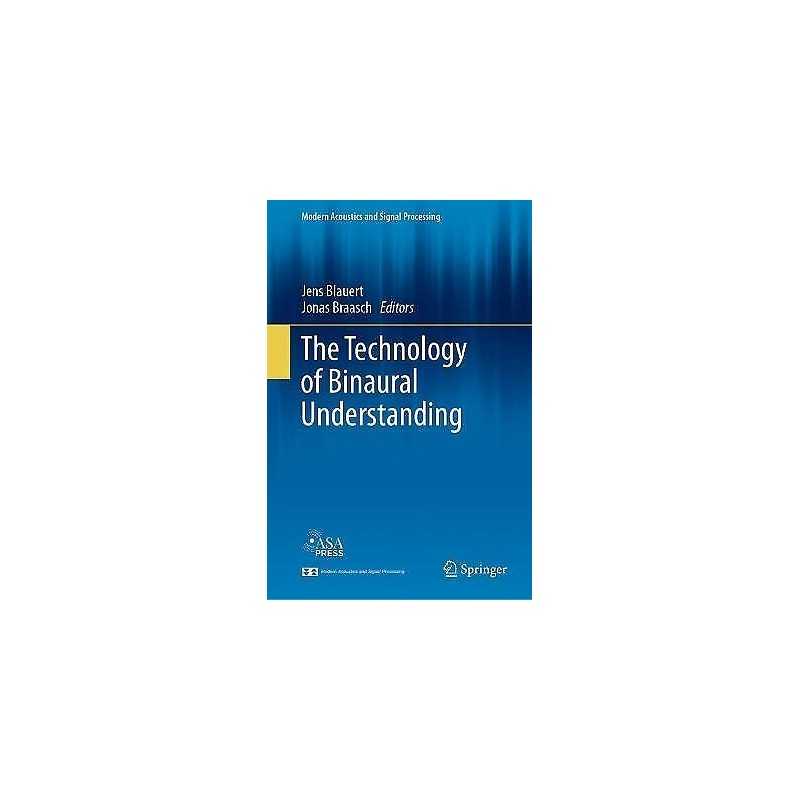
The Technology of Binaural Understanding - 9783030003852
New: A new, unread, unused book in perfect condition with no missing or damaged pages. See the ... Read moreabout the conditionNew: A new, unread, unused book in perfect condition with no missing or damaged pages. See the seller's listing for full details. See all condition definitionsopens in a new window or tab
Sound, devoid of meaning, would not matter to us. It is the information sound conveys that helps the brain to understand its environment. Sound and its underlying meaning are always associated with time and space. There is no sound without spatial properties, and the brain always organizes this information within a temporal-spatial framework. This book is devoted to understanding the importance of meaning for spatial and related further aspects of hearing, including cross-modal inference. People, when exposed to acoustic stimuli, do not react directly to what they hear but rather to what they hear means to them. This semiotic maxim may not always apply, for instance, when the reactions are reflexive. But, where it does apply, it poses a major challenge to the builders of models of the auditory system. Take, for example, an auditory model that is meant to be implemented on a robotic agent for autonomous search-&-rescue actions. Or think of a system that can perform judgments on the sound quality of multimedia-reproduction systems. It becomes immediately clear that such a system needs * Cognitive capabilities, including substantial inherent knowledge * The ability to integrate information across different sensory modalities To realize these functions, the auditory system provides a pair of sensory organs, the two ears, and the means to perform adequate preprocessing of the signals provided by the ears. This is realized in the subcortical parts of the auditory system. In the title of a prior book, the term Binaural Listening is used to indicate a focus on sub-cortical functions. Psychoacoustics and auditory signal processing contribute substantially to this area. The preprocessed signals are then forwarded to the cortical parts of the auditory system where, among other things, recognition, classification, localization, scene analysis, assignment of meaning, quality assessment, and action planning take place. Also, information from different sensory modalities is integrated at this level. Between sub-cortical and cortical regions of the auditory system, numerous feedback loops exist that ultimately support the high complexity and plasticity of the auditory system. The current book concentrates on these cognitive functions. Instead of processing signals, processing symbols is now the predominant modeling task. Substantial contributions to the field draw upon the knowledge acquired by cognitive psychology. The keyword Binaural Understanding in the book title characterizes this shift. Both books, The Technology of Binaural Listening and the current one, have been stimulated and supported by AABBA, an open research group devoted to the development and application of models of binaural hearing. The current book is dedicated to technologies that help explain, facilitate, apply, and support various aspects of binaural understanding. It is organized into five parts, each containing three to six chapters in order to provide a comprehensive overview of this emerging area. Each chapter was thoroughly reviewed by at least two anonymous, external experts. The first part deals with the psychophysical and physiological effects of Forming and Interpreting Aural Objects as well as the underlying models. The fundamental concepts of reflexive and reflective auditory feedback are introduced. Mechanisms of binaural attention and attention switching are covered-as well as how auditory Gestalt rules facilitate binaural understanding. A general blackboard architecture is introduced as an example of how machines can learn to form and interpret aural objects to simulate human cognitive listening. The second part, Configuring and Understanding Aural Space, focuses on the human understanding of complex three-dimensional environments-covering the psychological and biological fundamentals of auditory space formation. This part further addresses the human mechanisms used to process information
Good condition -A book that has been read, but is in good condition. Minimal damage to the book cover.The majority of pages are undamaged might be with some creasing or tearing, and pencil underlining of text. No writing in the margins, no missing pages.
Good condition -A book that has been read, but is in good condition. Minimal damage to the book cover.The majority of pages are undamaged might be with some creasing or tearing, and pencil underlining of text. No writing in the margins, no missing pages.
Good condition -A book that has been read, but is in good condition. Minimal damage to the book cover.The majority of pages are undamaged might be with some creasing or tearing, and pencil underlining of text. No writing in the margins, no missing pages.
Good condition -A book that has been read, but is in good condition. Minimal damage to the book cover.The majority of pages are undamaged might be with some creasing or tearing, and pencil underlining of text. No writing in the margins, no missing pages.
Very good condition -A book that has been read and does not look new, but is in excellent condition. Don't have obvious damage to the book cover. No missing or damaged pages, no creases or tears, no underlining or highlighting of text, and no writing in the margins.
Good condition -A book that has been read, but is in good condition. Minimal damage to the book cover.The majority of pages are undamaged might be with some creasing or tearing, and pencil underlining of text. No writing in the margins, no missing pages.
Good condition -A book that has been read, but is in good condition. Minimal damage to the book cover.The majority of pages are undamaged might be with some creasing or tearing, and pencil underlining of text. No writing in the margins, no missing pages.
Good condition -A book that has been read, but is in good condition. Minimal damage to the book cover.The majority of pages are undamaged might be with some creasing or tearing, and pencil underlining of text. No writing in the margins, no missing pages.
Good condition -A book that has been read, but is in good condition. Minimal damage to the book cover.The majority of pages are undamaged might be with some creasing or tearing, and pencil underlining of text. No writing in the margins, no missing pages.
Good condition -A book that has been read, but is in good condition. Minimal damage to the book cover.The majority of pages are undamaged might be with some creasing or tearing, and pencil underlining of text. No writing in the margins, no missing pages.
Good condition -A book that has been read, but is in good condition. Minimal damage to the book cover.The majority of pages are undamaged might be with some creasing or tearing, and pencil underlining of text. No writing in the margins, no missing pages.
Good condition -A book that has been read, but is in good condition. Minimal damage to the book cover.The majority of pages are undamaged might be with some creasing or tearing, and pencil underlining of text. No writing in the margins, no missing pages.
Good condition -A book that has been read, but is in good condition. Minimal damage to the book cover.The majority of pages are undamaged might be with some creasing or tearing, and pencil underlining of text. No writing in the margins, no missing pages.
Very good condition -A book that has been read and does not look new, but is in excellent condition. Don't have obvious damage to the book cover. No missing or damaged pages, no creases or tears, no underlining or highlighting of text, and no writing in the margins.
Good condition -A book that has been read, but is in good condition. Minimal damage to the book cover.The majority of pages are undamaged might be with some creasing or tearing, and pencil underlining of text. No writing in the margins, no missing pages.
Good condition -A book that has been read, but is in good condition. Minimal damage to the book cover.The majority of pages are undamaged might be with some creasing or tearing, and pencil underlining of text. No writing in the margins, no missing pages.
€17.97
New: A new, unread, unused book in perfect condition with no missing or damaged pages. See the ... Read moreabout the conditionNew: A new, unread, unused book in perfect condition with no missing or damaged pages. See the seller's listing for full details. See all condition definitionsopens in a new window or tab